Last night, as I tried getting my three year-old to sleep so I could play my brand-new copy of NHL 13, I had an epiphany of sorts. It dawned on me how much videogames influenced my real-life pleasures. And the story actually started a long time ago.
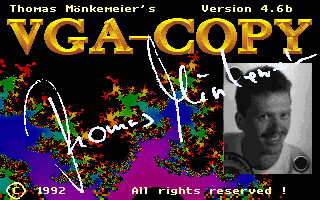
The story begins in a rather pleasant Saturday afternoon in late 1993. We went into a shoddy building, walked up the stairs to the first floor and found this rather unassuming office at the end of the hall. We skimmed over a thick catalog of game titles and started picking a few we wanted to try. They were cheap, pirated games. After selecting the titles, the guy there noted them down and asked us to wait. In the back, two guys got some floppy disks and started copying the games for us with VGAcopy. Nice!
Of the games we bought, only one I can still remember: NHL Hockey. To that day, I had only a general idea of what hockey was: Soccer on the ice. We picked it simply because the clerk there told us it was good.
We went home that day and probably tried some of the other, now-forgotten games, but then we installed NHL Hockey from the floppies to MS-DOS. We were both hooked instantly! The game had an arena atmosphere that later version never quite managed to reproduce. We did not know the many rules of hockey, we learned as we played. I remember vividly as my friend pumped up the volume on the PC when the game would play an 8-bit version of “We will rock you” while two cartoon hands clapped on the virtual jumbotron.
We played that game throughout that night and into Sunday. It was fast. It was fun. We were hooked. NHL 96 was the first game I ever legally bought. And I’ve bought almost every version since then.
Back to how it influenced my real-life, playing the game got me into Hockey as a sport. A Brazilian hooked on Hockey? Not supposed to happen, but one likes what one likes. It also indirectly started my love affair with Canada, but that’s a different story. Following Hockey was not easy until I found a radio that streamed games and later the League started offering live vide streaming for which I have been gladly paying an exorbitant amount of money for half a decade or so. I’ve experienced a similar effect thanks to the Madden and NBA Live series, but NHL Hockey will always be a special case for me.
I realized that thru hockey I’ve made friends, some of whom are real good friends. And all of this started because a couple of decades ago we got some pirated games in a Saturday afternoon.
Want to make a comment or suggestion? Do you feel like you need to correct me for not fitting the Standard Brazilian Specification? Feel free to talk to (or scream at) me, I’m @robteix on App.net and also on Twitter.
Much has been said about the pros and cons of anonymity lately, prompted by Google+ TOS which require the use of one’s real name. No pseudonyms allowed, except apparently if you call yourself Lady Gaga or 50 Cent.
I have seen many kinds of arguments both for and against the use of aliases and I will not repeat them here. There is however one use of aliases that I haven’t seen stated anywhere and that coincidentally affects me personally. Perhaps this is so because the problem I am about to present is not so common after all. Or perhaps it is common but people decide not to talk about it. I have no way of knowing.
Anonymity is a vital necessity to people with a certain kind of disability, a mental disorder. I am such a person. As some of my friends know and others mock, I suffer from a mental condition called social phobia, also known as social anxiety. I take medications that help me overcome some of the most serious effects and that allow me to do things like write about it on this very blog.
Social anxiety manifests itself in varying degrees in all kinds of social interactions. And the levels of manifestations are not what you might expect. I regularly make presentations without a second thought. I’ve given talks to hundreds of people. And yet, ordering a pizza over the phone is terrifying experience to me. No matter how many times I’ve done it, I still have to “prepare” myself every time. I rehearse, play several unlikely scenarios in my head until I finally get the courage to dial the number and talk to the person on the other side. One characteristic of this anxiety disorder is that rationally I know that there is nothing wrong; there is no risk in calling the pizza place. But the brain acts as if there were. But I digress.
I love coding. I have been doing it since I was a kid and it’s the best thing I know how to do. And then there is open source. Open source projects should be the perfect venue for me to have fun. Except I am scared stiff by the idea that someone might laugh at the code. It came to a point where it is impossible for me to contribute. Then I’ve come up with a solution: an alias. For the past several years I’ve lived two different lives online: one as myself and another as an alias. I keep them strictly separate.
Using the alias, I actively contribute to several different projects. And I enjoy it all. And it would be impossible for me to do that using my own name. My pseudonym allows me to work around my condition. It allows me to live my life.
I understand the rationale behind the requirement for real names on Google+. But I also know that the requirement makes it impossible for people like me to be really free on the Internet. So far, Google hasn’t figured out my alias. Hopefully it never will.
I’ve been spending an insalubrious amount of time on Google +. I managed to plump for a pretty good group to follow and as a consequence I’ve been getting consistently interesting content. As for myself, I mostly I post in English. A couple of days ago, I posted something most inconsequential and it would have been an unreservedly unremarkable post wasn’t it for the fact that it was geolocated in Cordoba, Argentina, which caused it to attract the attention of people nearby. In the middle of the comments, someone asked, in Spanish: “why is everyone speaking English?” That was a fair question and it touched something that has bugged me in the past.
Some part of my brain must miss the good old times of hunting and gathering as I ended up as a nomadic man—albeit one who doesn’t hunt and at most gathers food from grocery stores, so there might be a flaw in my theory. My rootless nature made me move a lot. This and the nature of my work caused me to make friends in several places other than my native Brazil1.
We’ve already established that I communicate in Portuguese. Working at a US-based multinational as well as with open source, I also use English quite a bit—and my aforesaid rootlessness has taken me to inhabit the beautiful state of Oregon in the past. Oh and did I mention I am currently putting in a tour of duty in Argentina?
The result of all of this—in blatant contrast with the pre-Tower of Babel times when everybody obviously spoke English—is that I communicate daily in multiple languages. There isn’t a day—well, weekday—I don’t have to speak Spanish, Portuguese, English and French with someone or another. And that is fine and actually quite nice: you do lose languages if you don’t use them. Not like riding a bike, I suppose. Regardless, it is not a problem to communicate 1:1 in those languages. But what about 1:many conversations?
Blogging is a clear example. Should I blog in Portuguese as some keep telling me I should? I cannot reasonably expect my non-Brazilian readers to understand Portuguese. If I write in French, my Quebecer friends will be happy but what about the rest? Nationalistic rants aside, English is an international language nowadays, just as Latin and French once were. Aside from very few people, the vast majority of the people I know can understand English and that’s why I use it most often than any other.
Ideally, one would use their own native language and computer translation would do the rest. Unfortunately we are not there yet. I will admit that computer translation is getting better and better and it is fairly good if you write clear, short sentences. And it will get better. But I am skeptic that we will ever get to the point where the algorithms will be able to deal with subtleties, innuendos and all the puns that make up human interactions.
The way I see, I currently have a few options –
I write in Portuguese, as the ever vigilant Brazilian crowd demands it. That would soothe the wrathful nationalists who believe me a Traitor Of The Fatherland™. But it also limits my already limited audience; not good.** **
I write multiple versions of the same thing in each language. That would begin to feel like actual work, not fun. Also, having tried that in the past, I’ve learned that after I was done with the first version, the others never came out naturally.** **
I write in English. Sure it makes me a bootlicking lackey of the imperialist Yankees in the eyes of the insecure, but it also helps me reach pretty much everyone I know.** **
But using English is not a perfect solution either. For once, I am obviously not a native speaker and thus have an imperfect and narrow vocabulary. As well, I don’t share the cultural experiences that help define the subtleties of English. And finally, there are heaps of topics that just feel wrong in English: such as local—as in Brazilian—topics. It just feels weird.
Back to Google+, I have created Circles for Portuguese and French, but these are not much valuable until Google comes up with some system of set arithmetic that would allow me to say something to the effect of “Post this to members of Circle X who also happen to be members of Circle French.” Until then, English is my best bet.
1 Experience tells me that I am required to point out that we, cheerful Brazilians, speak Portuguese, not Spanish.
I’m not a big believer in keeping books forever, even though I do keep some. Most books, however, I just want to read and pass along.
It just so happens that I have a ton of books that I want to get rid of. I could throw them away, but it somehow feels wrong. Also, I could donate them to some school, but considering where I live now, I assume this too will bring me one hell of a bureaucratic nightmare. Also, most of the books are either in English or Portuguese, so schools would probably not use them anyway.
With very few exceptions, all the books are either mathematics, economics, programming, or scifi. I thought I’d simply take the books to the office and give them away to anyone who’d like to have them.
But then my wife gave me an idea. Instead of taking the books and giving them outright, I started sending random emails to a mailing list with geeky questions, often related to the book topic. Whoever answers correctly first, gets the book.
This worked amazingly well.
It created a fun environment for all involved. People actually want to get the answers right. Others learn by, well, learning the winning answer.
For books that normally no one would care about, the fact that you have to win to get it suddenly adds value. It’s no longer a book no one wants, it now is an award.
All of a sudden everybody loves me 😉
Had I just announced I had a bunch of books, people would get by, pick a few they cared about and that would have been it. No fun. So every now and then I take a few books from home and then give them away to quiz winners.
Things are starting to get busier on my new project. It is, alas, still listed as Restricted Secret, which means I cannot really talk about its details. Nor could I even reveal its codename, even though codenames reveal nothing about what a project really is. For the sake of making referring to it slightly less annoying for me, I’ll refer to it using a made-up codename in the best traditions of the company’s history of naming things for lakes, peaks, creeks, and towns. So the secret project shall henceforth be known as Suquia Creek (being the creek across from my house.)
Since I cannot give any details on Suquia Creek, what could I possibly talk about? A lot, it turns out. I can talk about things I’m learning while working on the project.
Ah boy, am I learning!
It turns out Suquia Creek is going to be the longest, most complex project I’ve worked on. Until SC came along, the longest project of my life had been Lava Peak, which ran for about two years. But that included post-launch activities. We managed to go from ideation to shipping in just under a quarter (I even won an award because of that back in 2007.) Suquia Creek, on the other hand, is scheduled to ship in 2014! That’s nearly half a decade of work.
As well, for earlier projects I only had to worry about software. Suquia Creek, however, is also hardware. And on the software side, off the top of my head, it involves —
Processor µcode
Chipset code
BIOS extensions
Firmware code
Drivers
An SDK
User-level apps
And a few other things I can’t say without revealing more than I should.
Bottom line: it’s huge as far as I’m concerned! And we should support multiple versions of Windows and one distro release of Linux. It also involves several cross-functional, geographically-dispersed teams based mainly in Argentina and the US, but also with some smaller efforts coming out of China, India, and Israel. That amounts to six different timezones, for a current maximum time difference of 17 hours.
And then we come back to schedule. I have no idea what I’ll be doing at home during this weekend, but I have to have a rough idea of what we’ll be delivering on, say, week 41 of 2013! That assumes the world will not end in 2012, of course.
This week we had our first engineering meeting to plan on a tentative schedule. Late next month I’ll be flying around between Silicon Valley and Silicon Forest to work out the (semi-)hard schedule. By then, we’ll actually have one internal alpha release in place already. After that, we’ll have another alpha before our first “release”, an internal proof of concept, which will then be used by customer as part of a (quasi-confidential) pilot. The customer? One of the world’s largest… well, can’t say what is their industry yet. It’s huge though.
After that pilot I expect to be able to open up a bit on what the project actually does. In the meantime, I’m going to be sharing my learning experience.
It’s going to be an exciting half-decade for me :–)